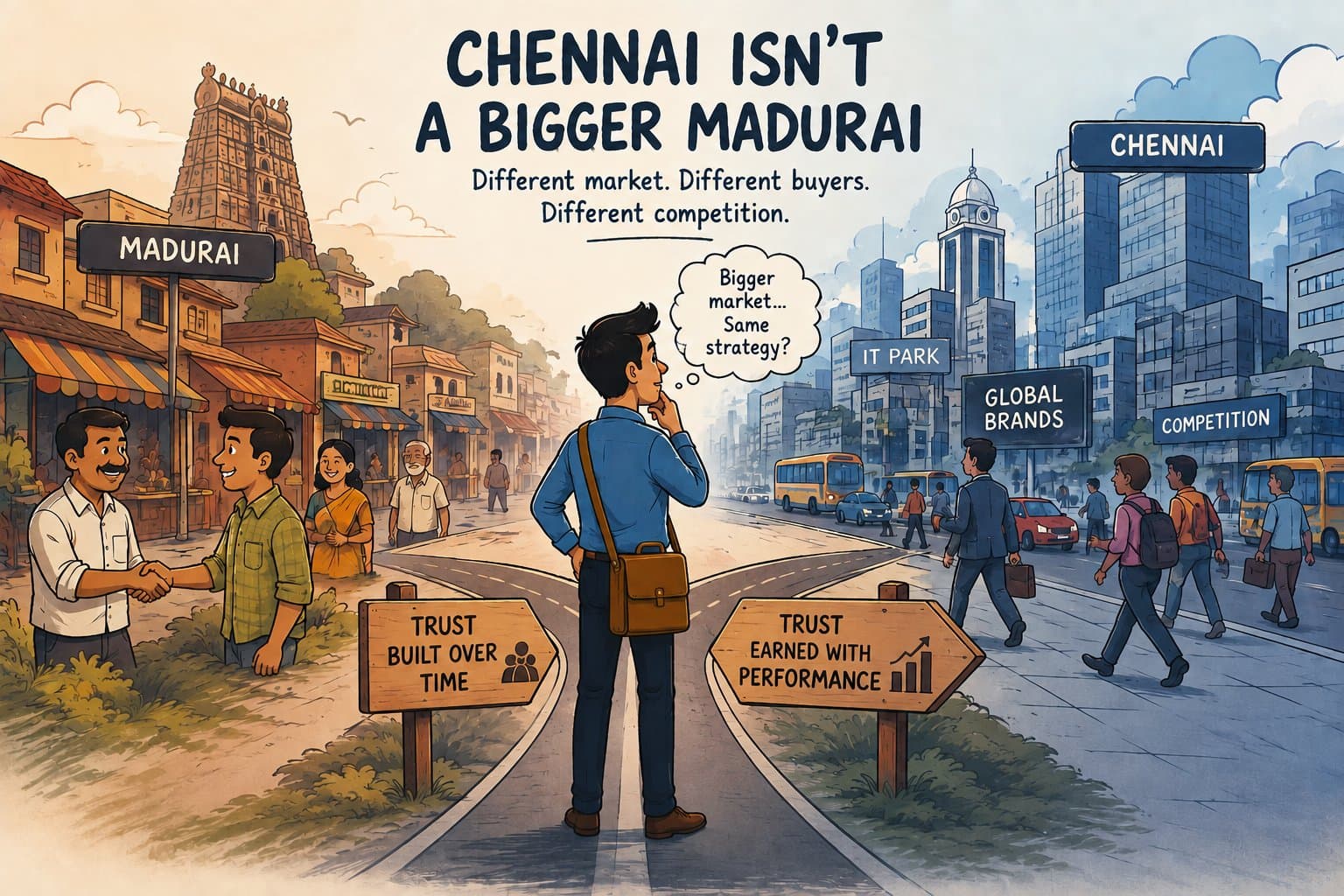
Chennai isn't a bigger Madurai. It's a different market, with its own buyers, its own competitors, and its own way of building trust. Businesses that expand from Madurai into Chennai succeed by treating it as a fresh market: proving the approach on a small scale, repositioning for buyers who have never heard of them, and building the systems needed to deliver consistently at a distance from home. Businesses that simply copy what worked in Madurai usually struggle, no matter how strong their reputation is back home.
## Why Chennai Isn't Just a Bigger Madurai
Chennai is often called the Detroit of Asia. It produces well over a third of India's automobiles, anchors one of the country's largest IT and BPO industries, and has become a leading hub for electronics and EV manufacturing. For a business that has proven itself in a market like Madurai, Chennai looks like the obvious next step: bigger population, bigger budgets, bigger opportunity.
But bigger isn't just more of the same. Chennai's buyers are used to dealing with larger, more process-driven vendors, and the competitive set already includes players with city-wide brand recognition built over many years. What builds trust in a tighter-knit market like Madurai, relationships, reputation, word of mouth, carries far less weight in Chennai, where a buyer might be choosing between dozens of vendors they have never heard of.
### The Trap of Assuming Your Strengths Travel With You
A business that has spent years earning a strong name in Madurai has an advantage that has nothing to do with its product: people know the owner, referrals flow naturally, and reputation does the selling. None of that history moves into Chennai. The business starts from zero there, competing against Chennai-based companies that already have that same kind of local trust. The product may still be excellent and the team may still be skilled, but the invisible advantages do not transfer. They have to be rebuilt, and that takes longer than most Madurai businesses expect, often a full year or more before the name means anything to a Chennai buyer on its own.
## Are You Actually Ready to Expand Into Chennai?
Not every business that has succeeded in Madurai is ready to take on Chennai. Readiness has less to do with how well things are going right now and more to do with whether that success can survive being copied somewhere else. A useful test: if the founder or a small core team were not personally involved day to day, would the quality of work stay the same? If a business depends heavily on one person's judgment or a tightly knit team's instincts, that is a warning sign, not a strength worth exporting to a market three times the size.
Expansion into Chennai also works best when there is a clear signal that the Madurai market is close to its ceiling, not just a vague feeling that growth would be nice, and when there is enough cash set aside to survive a slower-than-expected start. Chennai rarely makes money quickly for a new entrant, because winning a first-time customer with no prior relationship costs more than retaining a loyal one back home. A useful gut check before committing: can the business describe what makes it worth choosing without mentioning how long it has operated in Madurai or how well known the founder is locally? If the honest answer leans heavily on local familiarity, that advantage will not exist on day one in Chennai.
## Why Most Madurai-to-Chennai Expansions Fail
Most failed expansions into Chennai are not failures of the product. They are failures of assumption. The single biggest mistake is copying the Madurai playbook: the same pitch, the same pricing, the same message, dropped into a market where nobody has heard the business's name or knows its track record. Close behind is underestimating Chennai's competitive intensity, researching the market from the outside and noticing only the gap to fill, while missing how entrenched the existing players already are. A third pattern is ignoring how trust gets built differently. In Madurai, trust often comes from relationships and community standing. In Chennai, it comes from process: documentation, professional presentation, case studies, and consistent reviews. A business that only knows how to build one kind of trust struggles when the market expects the other.
## How Chennai Buyers Decide Who to Trust
Buyer behavior itself changes between the two cities, even when job titles look identical on paper. Madurai buying decisions often lean on personal trust: a friend's recommendation, a founder's local reputation, a long-standing relationship that outweighs a slightly better price elsewhere. Chennai buyers are more likely to be one voice in a group decision, following a structured, comparison-driven process that expects multiple proposals and visible proof rather than a personal pitch. A Madurai business new to Chennai also starts with zero brand recognition there, and unknown vendors typically need more proof, more reassurance, and more patience before a Chennai buyer takes a chance on them.
Online research plays a bigger role too: a Chennai buyer with no personal connection to a business will often check reviews, look for case studies, and search for proof before ever picking up the phone, which makes local visibility online part of how first impressions get formed. A Madurai business that has never needed a strong digital presence at home, because referrals did the work instead, often discovers this gap only after Chennai outreach quietly goes nowhere.
## Building a Market Entry Strategy for Chennai
A Chennai market entry strategy needs its own logic, not a bigger version of the marketing plan that worked in Madurai. It starts by accepting that reputation and brand recall do not exist yet in Chennai, which forces the business to build proof rather than assume it. Positioning has to be reworked around a simple question: why should a Chennai buyer, with dozens of options already available, choose an unfamiliar Madurai name over the alternatives they already trust? The go-to-market plan should assume the Chennai buyer has never heard of the business, leaning on visible proof, case studies, pilots, and reviews, rather than the personal networks that worked at home.
### Prove the Model Before You Scale It
Before hiring a large Chennai team or signing a long lease, the smarter move is proving the model works with a smaller footprint first: a remote start, a light local presence, or a handful of early Chennai customers, with a clear point built in from day one to review whether the evidence supports scaling further.
### Consider a Chennai Partnership Before Going Alone
A partnership with an established Chennai business can effectively lend a new entrant some of the trust it has not had time to build on its own. This is often faster and cheaper than trying to build that same trust from zero through advertising alone, though it does mean sharing some of the value with the partner in exchange for the head start. For a Madurai business with no existing Chennai relationships, this route is frequently underused simply because it was never needed at home.
## Get Your Operations Ready, Not Just Your Pitch
Strategy gets most of the attention in expansion planning, but operations quietly decide whether that strategy survives contact with Chennai's reality. In Madurai, a founder's personal involvement can paper over informal processes. That safety net disappears in Chennai, where a new team without daily founder oversight needs clear steps, clear ownership, and documented standards so quality does not depend on who happens to be handling it. If the reason something worked in Madurai lived only in someone's head, it cannot be copied into Chennai until it is written down.
Running two markets at once also creates a new challenge: keeping standards consistent without forcing a single rigid process onto two different contexts. The businesses that manage this well usually separate what must stay identical, core quality standards, pricing discipline, brand values, from what is allowed to adapt, messaging, channel mix, and day-to-day delivery details.
## Common Mistakes Madurai Businesses Make in Chennai
The businesses that expand successfully treat Chennai as a distinct market, not a bigger version of Madurai: a positioning that explains why a Chennai buyer should choose an unfamiliar name over an established local option, a go-to-market plan built for a market where nobody already knows them, and enough operational discipline to deliver consistently once the first few deals land. A bigger Chennai marketing budget does not fix unclear positioning either; it just pushes an unclear message in front of more people faster. Metro markets also create pressure to look established quickly, tempting Madurai businesses to hire ahead of proven Chennai demand and lock in costs before the model has earned them. And underpricing to win early Chennai customers is hard to reverse later, since a market that anchors on a low price resists paying more once it has gotten used to it.
## Budgeting for the Move to Chennai
Budgeting for a Chennai expansion needs to include the costs that are easy to miss. Beyond the visible expenses, travel, a local presence, and marketing spend, there are hidden costs: a slower sales cycle caused by buyer unfamiliarity, extra leadership time spent overseeing a market the founder does not know as well, and the cost of early mistakes made while learning how Chennai buyers actually behave. A workable approach is to estimate the expected cost, then add a meaningful buffer and a longer timeline than feels comfortable, since markets that turn profitable faster than planned are a pleasant surprise, while markets that take longer than a tight best-case budget allowed for are what force rushed decisions.
## How to Know Your Chennai Expansion Is Working
Whether the Chennai expansion is working should be judged by real signals, checked regularly, not by assumptions made on day one. Useful signals include whether Chennai buyers are responding to outreach at a reasonable rate, whether deals are converting through the new go-to-market plan rather than relying on personal connections back in Madurai, and whether the cost of winning a new Chennai customer is trending down over time. If positioning still is not resonating after a fair test, and costs remain high with no improvement despite real effort, it is worth stepping back and asking honestly whether Chennai was the wrong market to enter next, or whether the execution needs a rework, rather than assuming the outcome alone tells the whole story.
## What a Realistic First Year in Chennai Looks Like
Madurai businesses that plan for a realistic first year in Chennai tend to fare better than those chasing a fast win. The first few months are usually about research and small, low-risk tests, not signed contracts: talking to real Chennai buyers, testing messaging, and identifying which parts of the Madurai offering need to change. The middle stretch is where proof gets built, a handful of early customers, case studies, and reviews that make the next pitch easier than the last. Revenue that actually justifies a larger local investment, a bigger team, a permanent office, a wider marketing push, usually shows up later than founders hope, and treating that delay as normal rather than a warning sign is part of what separates expansions that survive their first year from those that get pulled back too early out of impatience.
### How Cup N Saucer Helps With This
This is the exact gap we work in. We've helped Madurai and Tamil Nadu businesses plan and run their move into Chennai: sizing the opportunity honestly, rebuilding positioning for buyers who have never heard of the name, and designing a go-to-market plan built for a market where nothing is inherited from home. We also help set up the operational discipline, documented processes, clear ownership, a review cadence, that keeps quality consistent once a Chennai team is running day to day without the founder in the room. If you're weighing whether Chennai is the right next step, or you've already started and the traction isn't matching the effort, that's a conversation worth having before more budget goes in.
## The Bottom Line
Chennai isn't a bigger Madurai. It's a different market, with its own competitors, its own way of building trust, and its own rules for what works. Expansion doesn't create strengths and gaps that weren't already there, it just multiplies whichever ones exist. The Madurai businesses that succeed in Chennai are rarely the ones with the biggest budgets. They are the ones willing to test their assumptions instead of trusting them, and to let evidence from the new market, not past success in the old one, decide how fast they move.
Want to apply this to your business?
Book a strategy call